lördag 7 september 2024

THE KNIGHT TEMPLAR

Author: Jan Guillou
Year: 1999
Publisher: Piratförlaget
Language: Swedish

It has been ten long years since the last pages of the first book in Jan Guillou’s trilogy about Arn Magnusson were turned. Arn, serves his penitence as a Knight Templar in the Holy Land where he has been promoted to lord of a remote castle south of Jerusalem. His beloved Cecilia endures her own purgatory, confined within the austere walls of a convent presided over by a spiteful abbess, a sworn foe to the ancient bloodlines from which both Arn and Cecilia descend. To debate who among them suffers the greater agony is futile. For while Arn strides across the stage of history, his stature rising amidst the revered ranks of one of Christendom's most formidable orders, Cecilia is entombed in a stone sarcophagus, where each breath is a silent rebellion against the tyrannies of a cruel and relentless gaoler who delights in her power to torment and subdue.

As with the opening volume of this series, the author's command of history is both impressive and nimble, allowing him to weave thread after thread of fact into a credible and absorbing universe. He summons forth the towering figures of the age with both elegance and ease. Saladin, resplendent in his court of many a historical character, along with a cavalcade of kings, dukes, knights, and bishops from the Christian realm. He even manages to inserts a brief but ridiculous encounter between Arn and a youthful Sir Wilfred of Ivanhoe, a tongue-in-cheek jab at the venerable Sir Walter Scott, the unsurpassed master of the genre.

Jan Guillou, furthermore, continues to craft exquisite landscapes for his readers, drawing them effortlessly into the sun-scorched deserts of Palestine or the shadowed, sombre halls of Gudhem nunnery. He has an unquestionable talent to conjure these distant worlds into vivid being without succumbing to the dreariness of exhaustive description. In Guillou's prose, action remains ever at the forefront, yet we are never deprived of the sights, scents, and sounds of the protagonist’s surroundings. With each turn of the page, we find ourselves immersed in a world that feels startlingly alive.

Also similar to the first book, alas, the plot itself and particularly the characters remain downright childish, evoking the unmistakable impression of a boyhood fantasy in the head of a nine-year-old sprawled on the floor, fighting battles with his toy knights and horses, albeit dressed in the vocabulary of a grown man. The main protagonist, Arn Magnusson of Arnäs, is so impossibly perfect that even Our Lord might cast a jealous glance his way. Arn, after all, speaks no fewer than four languages without an accent, is undefeatable in battle, possesses a mind that fathoms all mysteries, and foresees every manoeuvre of his foes with uncanny precision. He is a master not only of architecture, engineering, medicine, politics, and military strategy but of history, the Bible, and the Quran as well. His temper is a paragon of restraint (with one exception) and his honesty is as unwavering as his chastity as he remains devoted to Cecilia for two decades without so much as a flicker of romantic attraction to another woman, despite having known his fiancée only fleetingly as a teenager. In short, there is nothing Arn cannot achieve, nothing he does not know. He is not merely the finest warrior among the Knights Templar but, indeed, the finest human to have ever graced this earth. To the discerning adult reader, this portrait of a man, more suitable for a 1960s superhero comic than a historical novel at the dawn of the 21st century, might be either laughable or boring … or both.

Arn is hardly alone in his condition of implausibility. In Guillou's novels, the line dividing the virtuous from the villainous is typically drawn with the crystalline brightness of a child's crayon. The good are perfectly angelic, the wicked irredeemably diabolic, and never the two shall meet. In this moral landscape of stark absolutes, there is no room for the subtleties of human nature, no weaknesses, no flaws, no shades of grey to lend depth or credence to the characters.

All that being said, in our present age, where human wretchedness is celebrated, where theft, mendacity, treachery, pettiness, ignorance, and stupidity are hailed as virtues, and where the worst of our kind are exalted to rule, it can be liberating, if only for a moment, to dive into a world where integrity, compassion, and honour still carry weight. Guillou does not show us what humans are like. He shows us what they should be like. Thus, I find it hard to dismiss Guillou entirely as a mere purveyor of the banal. For while I am fully aware that the quality of this book is highly questionable, I cannot deny that a part of me looks forward to the third and final instalment of the trilogy with some anticipation.

I have, perchance, stumbled upon my guilty pleasure, my literary sanctuary if one will. But if that be the case, all of you who make up the society of today are to blame.


torsdag 29 augusti 2024

THE CITY OF MY DREAMS

Author: Per Anders Fogelström
Year: 1960
Publisher: Albert Bonniers Förlag
Language: Swedish 

“Mina drömmars stad” (“The City of my Dreams”) is the first of five books in Per Anders Fogelström’s classic Swedish epic informally known as the “City”-series, which unfolds the grand tale of Stockholm across several generations, from the second half of the 19th century to the middle of the 20th. In this first book, we find ourselves in the company of Henning Nilsson, a poor farmhand turned worker after having forsaken the countryside and to seek his fortune in the city. Industrialisation is well underway and the smoky and clattering leviathan of the expanding urban production machine hungers for labourers to man its factories, warehouses, ports, railways, and road constructions. Henning, undeterred by his youth and unimpressive physical strength, tries his luck in several different trades but in the end, dedicates his life to the rough and relentless port as a docker, compensating with commitment what he lacks in physique.

Through Henning’s experience, Fogelström takes us on a journey to a Stockholm of yore, to a time where this city began its long and cumbersome transformation from a provincial backwater on the northern outskirts of Europe to the regional metropolis it is today. The Stockholm of a century and a half ago, was a place barely recognisable, a forsaken accumulation of crumbling shacks and dilapidated huts, housing the most wretched of humanity such as impoverished workers, thieves, prostitutes, beggars, drunkards, and vagabonds. In these odious circumstances, man and women were grappling daily with the cruel game of survival as the meagre coin they earned stretched only to cover a fraction of their most acute wants.  It is a dark, filthy, and miserable world where despair clings to every cobblestone.

“The city was ruthless. It offered no quarter to the fearful. Every moment demanded courage.”*

Children hold a place of particular significance in Fogelström’s prose, commanding his devoted attention and meticulous care. It seems like the writer takes great pains to ensure that every facet of the proletariat is laid bare so that no one goes unaccounted for, no matter how young. The poverty and decay are examined from every conceivable angle and retold in unmasked detail.

And yet, Fogelström does not seek to cast us into despair. Although there is no effort to gloss over the squalor, his narrative glimmers with the humble brightness that Stockholm could offer even to the poorest of its flock. Amidst a world where there is no shortage of souls who wish to take advantage of Henning Nilsson and where employers who underpay and overwork him are legion, he still finds true friendship and love. Little by little, Fogelström reveals to us how a man of character and steadfast resolve can carve out room for himself even in a city where the surroundings, the customs, and the very way of life seem alien. In so doing, he reminds us how happiness may find even the most destitute of men.

Each character is crafted with exquisite precision. There is Henning’s friend Tummen, a man who knows everyone worth knowing, and can land a job, a room, or a bottle when they are needed the most, all the while nursing grand dreams of a workers’ revolution. Then there is Lotten, the washerwoman’s daughter, who, despite her scant means, insists on a home kept immaculate and clothes always in order, as if defying her poverty with each stroke of her broom. Annika, the daughter of a brutish coalman, pours every ounce of herself into the ambition of marrying out of her class. And Klara, with the unmistakable spark in her eye, who drifts into prostitution for the sake of convenience and learns to bear its bitter consequences.

Though the novel makes little reference to the precise era in which it is set, there are subtle clues strategically scattered throughout the narrative. Here and there, the reader will find the telltale imprints of historical figures, institutions, and events accurately woven into the story collectively, each serving as a timestamp for the reader to make note of. For example, August Strindberg’s novel “The Red Room” was published in 1879 and made a huge impact. Fogelström writes:

“Soon she left again. Lying down, Henning glanced at the book. ‘The Red Room – Scenes from the Life of an Artist and Writer’”

(For more on The Red Room, see my review from January 2023)

The title, finally, “Mina drömmars stad” is exquisite. It encapsulates the dual nature of desire, the fervent hopes and lofty dreams of those who abandoned the fields and farms of rural Sweden in search of a brighter existence in Stockholm, and the poignant yearning for a future forever out of reach, an imagined paradise that for many never quite arrived. The Swedish poet Lars Forssell, ten years Fogelström’s junior, captured the illusions that some rural dwellers harboured for the rapidly expanding capital city at the time.

“The streets in Stockholm are made of gold – I think. Purple drapes hang from every house.
No man will another indebted hold – I think. No one’s poor like a lowly louse.”*

It seems that in the end of the day, dreams were all that the city was able to deliver. And ultimately shatter.

*My own translation from the Swedish original 


söndag 11 augusti 2024

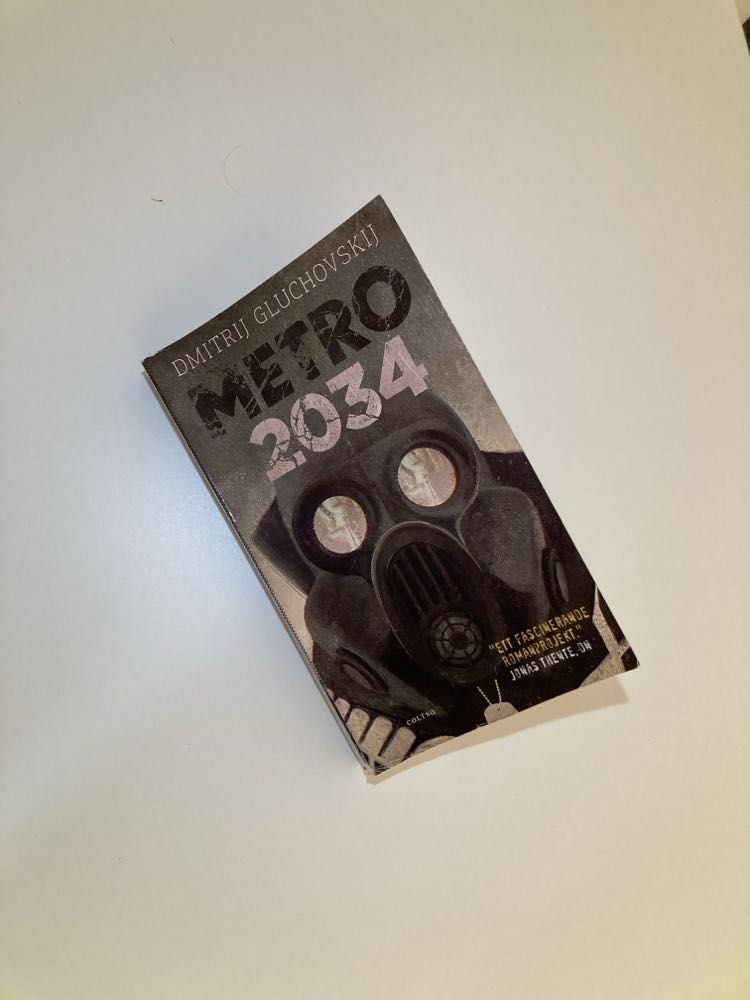
METRO 2034

Author: Dmitry Glukhovsky
Year: 2017 (2009)
Publisher: Coltso
Language: Swedish (Translator Ola Wallin) 

Dmitry Glukhovsky’s book, “Metro 2033” (as discussed in my review from June 2024), though not without its shortcomings, achieved a remarkable success. Despite the passage of over fifteen years since its publication, and a full decade since it was launched to stardom by means of a popular video game adaptation, new readers continue to find their way into his imaginatively wrought post-apocalyptic world, set in the Moscow underground. Yet, there appears to be a consensus among them on one particular point: the sequel, “Metro 2034”, is far inferior to the first book.

“Metro 2034” is set a year after the events of “Metro 2033” and follows a largely different cast of characters than the first volume. However, one familiar hero does return, and with a role of even greater significance than before: Hunter.

Hunter is among the most skilled fighters and trackers in the entire metro, and a master of survival. His reputation precedes him as one who shoots first and asks questions later, harbouring no scruples about sacrificing innocent lives in pursuit of the idea of a greater good. His idea, to be more precise. In “Metro 2034”, he teams up with the significantly more sensitive and poetic adventurer, Homer, on a quest to rescue the remining shards of mankind dwelling in the metro tunnels from certain doom. On their journey, they encounter the sole female character to appear thus far in the series: Sasha.

For natural reasons, the second book differs significantly from its predecessor. It is quite understandable that Glukhovsky composed “Metro 2033” with a distinct political agenda in view; an agenda that reached its fulfilment by the conclusion of that volume. In the sequel, however, there is no longer an agenda to guide the narrative. What remains is merely the post-apocalyptic world itself, and thus the author is obliged to devise a new story. One that must adapt to a world originally crafted for an entirely different purpose.

Glukhovsky does this with a fair degree of success. Unlike the first book, which often read like a series of disconnected events hastily assembled to form a story, this time the storyline is more coherent and easier to follow. The political and philosophical digressions are fewer, giving way to a more action-driven central plot. For those who appreciated the reflective qualities of “Metro 2033”, “Metro 2034” may appear somewhat barren and banal, yet those in search of suspense and action will likely find it quite satisfying.

Still, there is wisdom to be found in the second volume as well. Notably, I find a contemplation of Thomas Hobbes' “Leviathan” (see my review from April 2022) through the prism of the Metro saga thus far to be particularly intriguing. Hobbes posited that in a society bereft of a centralized authority incorporated as an unopposed arbiter, the state of nature would inevitably devolve into a perpetual war of all against all. Only by surrendering our freedom and subjecting ourselves to oppression can we ensure that others are equally oppressed and thereby rendered incapable of harming us. Glukhovsky, however, presents us with a different perspective. In his world, the central power has been annihilated by war, leaving the survivors to contend with one another for the scarce resources that remain available. Yet, Hobbes' vision of a universal state of war does not entirely come to pass. Rather than individuals engaging in their own solitary one-on-one struggles, people band together to form communities, often, and this is key, defined by their opposition to another community. The state of war, as envisioned by Hobbes, does materialise to some extent, but not between individuals; rather, it arises between collectives. Within these collectives, conformity and cooperation are fostered not through the imposition of a judge and punisher, but through the rational choice to unite in the face of an external foe.

Beyond this, the continued scarcity of impactful female characters continues to plague this series. Granted, we are introduced to Sasha, and while her role is not entirely unjustified, the overwhelmingly masculine nature of the world is only accentuated by the presence of a damsel in distress who, after being rescued, endeavours to redeem a man who has seemingly strayed into ruthlessness and violence. Such a trope is far too clichéd not to be conspicuous, particularly in light of the glaring absence of other female characters.

In conclusion, I found myself far less disappointed by this book than some other readers, perhaps owing to my not having been as captivated by the first as they had been. In my view, this sequel proved to be a worthy and moderately enjoyable continuation, with its literary merit still largely dependent on the excellent worldbuilding and captivating settings. Indeed, the principal characters were actually more engaging here than in the initial volume. All in all, Glukhovsky has sustained both pace and altitude with this work. “Metro 2035” now beckons.


tisdag 30 juli 2024

THE ROAD TO JERUSALEM

Author: Jan Guillou
Year: 1998
Publisher: Piratförlaget
Language: Swedish

Jan Guillou stands as one of Sweden’s most prominent authors of action literature, whilst also being a renowned, and oftentimes controversial, columnist with radically left-leaning political views. His most celebrated work, which catapulted him to literary prominence in Sweden during the 1970s, is perhaps the autobiographical novel "The Evil" which lays bare his supposedly harrowing experiences as a youth of modest origins amidst the privileged confines of a prestigious private school. Guillou's stature as a writer of action was ultimately solidified with the overwhelming success of his Coq Rouge-series in the 1980s and 1990s, wherein he recounts the daring exploits of a Swedish nobleman and military intelligence officer.

Guillou has since then proven himself to be a prolific writer, delighting in the exploration various eras and frequently displaying a bias to book series about his favourite protagonists. Among thsese is the medieval knight Arn Magnusson of Arnäs hailing from West Gothland in what would later become part of the unified kingdom of the Swedes and the Geats, today simply known as Sweden. The first volume of a series of three concerning Arn is entitled “Vägen till Jerusalem” (“The Road to Jerusalem”).

Arn, the second son of the head of one of the most illustrious families in West Gothland, is offered to a local monastery as a child, a token of gratitude by his parents to God for sparing his life in what ought to have been a fatal accident. Growing up among the Benedictine monks, Arn is immersed in their teachings. Beyond the expected studies of the Bible, philosophy, Latin, and geometry, he also gains knowledge in biology, medicine, engineering, and architecture. Most significantly, one monk, once a Knight Templar, instructs him in the arts of horsemanship, swordsmanship, and archery. To the astonishment of the Benedictines, and unbeknownst to himself, Arn matures into a formidable fighter, a knight without equal in the Nordics. His destiny is irrevocably set when, upon reaching adulthood, he is sent forth from the monastery's walls to seek God’s purpose in the wider world.

It is always a delight to read well-researched historical fiction, and "Vägen till Jerusalem" is indubitably founded upon solid historical study. The political struggle for power and the initial steps towards the unification of the Western and Eastern Geats and the Swedes are portrayed with great accuracy. Fictitious characters are interwoven seamlessly with authentic historical figures, although Guillou permits himself some artistic license on occasion. The storyline proves compelling, and the language is both brisk and straightforward. Mr. Guillou skilfully employs his journalistic prowess to captivate the reader and sustain their interest throughout.

Having said that, the downside of Guillou’s narration technique is a certain lack of depth in the storytelling. The characters’ actions appear to bear more significance to the story, and indeed the author, than to the characters themselves. Whenever an action or a word risks being ambiguous, Guillou is quickly there with his pen to ensure that the reader comprehends the underlying intention. Furthermore, every character is either impeccably virtuous or completely reprehensible. They are either angelic or satanic. There is no middle ground. All of this, in total, renders Guillou’s world-building somewhat flat and, to speak candidly, reveals many of the unmistakable signs of a juvenile writing style.

“Vägen till Jerusalem” is certainly not a great work of art and due to the aforementioned shortcomings, to a degree misses the mark as entertainment, too. While I appreciate the historical setting and Guillou’s choice to situate the narrative in an era of Swedish history that is largely ignored by the Swedish educational system and thus widely underexplored by most Swedes, I do hope that he will allow both the story and the characters to gain complexity in the subsequent volumes of this trilogy.   


måndag 15 juli 2024

THESE HAPPY YEARS

Author: Agnes von Krusenstjerna
Year: 2010 (1937)
Publisher: Albert Bonniers förlag
Language: Swedish

In the third instalment of Agnes von Krusenstjerna’s tetralogy, the main protagonist, Viveka, enters her teenage years and has her first brush with desire for the opposite gender. She had, of course, experienced puppy love in the preceding books, most notably with her aloof cousin Donald, but as she begins to mature, her capacity to love and feel desire also develops. This will have significant ramification for Viveka’s further choices. 

In “Dessa lyckliga år” (“These Happy Years”), Viveka’s father retires from his esteemed career as an army colonel necessitating the family’s departure from the spacious provincial residence in favour of a modest flat in central Stockholm. Sofia, Viveka’s mother, who is never too shy to allow her own desires eclipse any concern for her daughter’s needs, assigns a scruffy corner in one of the few and narrow rooms to Viveka, allowing her to fashion a much-desired enfilade, a pitiable attempt to maintain a semblance of upper-class elegance when entertaining friends and acquaintances. The retired colonel eventually secures a position as an auditor with a prominent industrial firm owned by one of his distant acquaintances. The additional income derived from this position is scarcely sufficient to keep the family afloat in the lowest levels of the urban aristocracy.

The Lagercrona-family’s continuous struggle, and failure, to preserve an appearance of affluence is further exacerbated during Viveka’s early teenage years.  She is not only relentlessly scrutinised by members of considerably richer branches of the family, but she is also thrust into the unfamiliar world of city life with its obscure rules and expectations. This new environment presents a host of challenges, compelling Viveka to navigate the intricate social minefield of urban society while under the critical gaze of her more prosperous kin.

As Viveka grows older and takes her first steps in what is supposed to be the social life of a young girl from the nobility, the adverse effects of her upbringing under an egotistic and emotionally volatile mother start to become increasingly apparent. Viveka, beset by profound insecurity and low self-esteem, finds every social encounter to be an emotional rollercoaster. She falls in love with alarming ease yet considers herself too inconsequential to even deserve to be spoken to. She is frightened and horrified by each new situation or each new acquaintance. She is plagued by doubt about her clothes, her looks, her voice, her opinions, her name, and indeed her very existence. Every action becomes a daunting ordeal, every encounter a battlefield, every acquaintance a threat, every word a barbed arrow to her heart. In her distress, Viveka tries to hide, she weeps, and she is sick to her stomach throughout most of this novel.

The exaggerated emotional reactions would border on the tiresome, were it not for the realisation that the narrator is an emotionally deeply disturbed individual. Short of the self-destructive behaviour, Viveka exhibits signs of what modern psychiatry might consider Emotionally Unstable Personality Disorder (EUPD), including erratic emotional responses to seemingly insignificant stimuli, crippling anxiety, and extreme self-doubt. The notable absence of self-destructive behaviour and self-harm can potentially be attributed to her quasi-paralytic inability to act at all, a constant state of pacification and fear that would align with the diagnosis. Indeed, a chaotic or traumatic childhood is cited in the medical literature as the primary cause of this disorder.  

Krusenstjerna’s portrayal of the floundering social class and the detrimental individual effect it had on its members is a triumph of literary accomplishment and an important historical document. Her decision to observe this decline through the eyes of a child who matures with time is particularly compelling. By following Viveka across the first three parts of this tetralogy, we have so far got to see the inevitable expiration of the aristocracy through the eyes of a child, an adolescent, and a young adult respectively, all of which are perspectives that contribute uniquely to the depth and nuance of the total picture.

It was hinted in the prologue to the first book “Fattigadel” (see my review of March 2024) that Viveka’s life would not end happily. By the time the events in “Dessa lyckliga år” unfold, it becomes evident that the essential tools for navigating any stratum of society, be it the aristocracy, the bourgeoisie, or the proletariat, have been systematically denied to her throughout her upbringing. Her mother, with her own capricious motives, but also her brothers and her extended family played a pivotal role in this depravation. Viveka von Lagercrona is a personal tragedy waiting to happen. I am intrigued by how Krusenstjerna will weave these threads together in the fourth and final book. Stay tuned.


söndag 30 juni 2024

UNDER THE NORTH STAR - III

Author: Väinö Linna
Year: 1988 (1962)
Publisher: Wahlström & Widstrand
Language: Swedish (Translator N-B Stormbom) 

Yea, drive us together with scourges,
and bluest spring shall bud.
You smile, my people, but with stiff features,
and sings, but without hope.*

Verner von Heidenstam’s famous poem “Invocation and Pledge” from 1899 reflects upon a Sweden basking in its own comfortable complacency at the turn of the century. With the discerning eye of a poet, Heidenstam contends that only through the bitter taste of adversity might the Swedish people awaken and re-discover the sweetness of unity, patriotism, and freedom. In the same manner that an individual having faced a near-death experience comes to value life more deeply, Heidenstam aspires for an existential challenge to invigorate the Swedish nation with a newfound strength and energy.

It was, of course, a trifle for a nobleman such as Verner von Heidenstam to recline in his gilded upper-class bubble and bemoan the lack of sufficient trials for his less fortunate countrymen. Sweden in the early 20th century was by no means overflowing with riches. Poverty in the wake of rapid industrialisation and urbanisation was widespread, infant mortality was around ten percent, and famine and diseases ravaged many parts of the kingdom. Between the years 1850 and 1920 over 1.5 million Swedes, driven by hunger and despair, sought solace and sustenance across the Atlantic in North America.

Even so, no Nordic nation has experienced a transformation more brutal and profound than that of the Finns. After their independence from Russia following the First World War, a brief but savage civil war between the landowning and capitalist elite on the one side and the landless and the proletariat on the other (see my review of Linna from April 2024) ensued. The war, although short-lived, inflicted deep wounds upon Finnish society. Wounds that would prevail until the Finnish people was ‘driven together with the scourges’ of the Second World War.

Individuals who had once grown up together only to later find themselves locked in blind rage and mortal combat, now stood shoulder to shoulder in the trenches defending Finland from the Soviet onslaught in 1939. Communists and Nazis fighting side by side, presenting the Red Army with an unexpected and formidable resilience.

During the interbellum years, progress did not omit Finland. Both men and women were granted the right to vote, crofters were allowed to acquire the land they worked, technology opened up for new business opportunities and improved productivity. The world changed and Finland changed with it.

Väinö Linna in the final instalment of his trilogy “Under the North Star” captures this transformative process with unparallelled sublimity. Despite the horrendous memories of the civil war and the harrowing loss of loved ones at the hands of their fellow countrymen, life slowly finds a new equilibrium. Amidst an atmosphere thick with suspicion, scorn, and silent resistance, a fragile tranquillity engulfs the small town. However, it is the cataclysm of the Second World War that ultimately serves as the catalyst for the national healing.

With “Söner av ett folk”, Väinö Linna ties his magnum opus together in the most spectacular way and sends his beloved Finland off into the future as a fatigued but united, confident, and free nation. This literary masterpiece should be mandatory reading for all Nordic school children and the literature of choice for anyone who values an exquisitely crafted narrative featuring vivid characters over some of the most troublesome and yet auspicious decades in Finland’s history. Putting this book down for the last time was like parting with a group of dear friends. I cannot recommend this trilogy enough.

*Shady, uncredited translation I found on the internet. Couldn't be bothered to make may own this time.


lördag 8 juni 2024

METRO 2033

Author: Dmitry Glukhovsky
Year: 2013 (2008)
Publisher: Ersatz 
Language: Swedish (Translator Ola Wallin) 

Whenever I find myself amidst the bustling allure of Moscow, I invariably check in at the same hotel in Tverskaya-Yamskaya Road, a mere two-minute walk from the Belorusskaya metro station. If one exits the hotel through its rear gate, one will find a shortcut leading to a side entrance of the station, right opposite of an unassuming white church contrasting against the otherwhile grey concrete architecture. This particular station is strategically convenient, nestled as it is adjacent to Belorussky vokzal where the airport train from Sheremetyevo Airport stops. Moreover, it straddles both the circle line and the direct line to Tverskaya and Teatralnaya stations, both of which are situated in the heart of the city and connect to several other metro lines. Some of the most iconic Moscow metro stations, such as Komsomolskaya and Mayakovskaya, can be reached from Belorusskaya without the trouble of changing trains.

With this experience and more from Moscow, I jumped eagerly into Dmitry Glukhovsky’s sensational novel “Metro 2033”. This dystopia envisions a near future in which the world is reeling from a nuclear war that has annihilated most civilisations and relegated whatever shards of humanity that remain to a subterranean existence. In Moscow, the fortunate few that have survived have settled in the winding labyrinths of the metro system, each station becoming a microcosm of society, constituting its own community with its own government and lifestyle. Some stations have come together to form alliances, others are ensnared in warfare.

The main character, Artyom, lives with his foster father in one of the fringe stations at the periphery of the inhabited part of the metro. His station is routinely attacked by mysterious creatures that ostensibly inhabit the desolate surface. To find a way to vanquish these murderous intruders once and for all, Artyom is assigned the secret task of delivering a vital message to a high-ranking military officer stationed at a remote part of the metro. And so, the quest begins.

There is a lot to like in this novel. The story’s premise is downright superb and Glukhovsky’s captivating prose quickly envelops the reader and thrusts them helplessly into the dimly lit tunnels of the underground. The milieu is exquisitely portrayed, conjuring vivid images of the claustrophobic environments and the constant threat of hostile human factions, slaughterous beasts and mutants, toxic gases, and deadly radiation. The sense of peril is omnipresent, palpable, and intense.

The storyline itself is simple but functional, dutifully mirroring the archetypal framework of most fantasy novels. There is the unlikely hero, the journey, the secret message or sacred item, the friends and foes the hero meets on his path, and the final resolution in the end. All staple ingredients of the genre.

Yet, the novel is not without some notable deficiencies. First of all, Artyom remains a rather uninspiring figure throughout the book. His character development is virtually non-existent, rendering it increasingly difficult for the reader to remain invested in his fortunes. Moreover, many of the situations he encounters on his journey seem to contribute little to the advancement of the plot. Rarely does one encounter has any effect on subsequent events and Artyom is rescued from his predicaments by what can best be described as deus ex machina miracles more often than by his own craft or any experience he might have gathered from his travels.

The reason for this is in fact rather straightforward. Glukhovsky has never been shy to publicly advertise his political views* and in “Metro 2033”, his protagonist becomes a vehicle for his opinions. On his journey, Artyom happens upon a multitude of political, religious, and philosophical interest groups, each judged by their actions toward him and each other. The purpose of each episode is to scrutinise the group or sect in itself through the prism of Glukhovsky’s political preferences, rather than to incorporate it into a cohesive string of a forward-moving narrative.

A more perplexing observation is the near total absence of women in Glukhovsky’s underground world. Besides a few fleeting references to Artyom’s deceased mother, there is no mention of any female character of consequence. There are no women in Artyom’s environment at his home station. He encounters no women on his mission. Neither Artyom nor any of the men he meets harbours any romantic or even crudely carnal attraction toward the opposite sex. There is not one single dialogue between a man and a woman except for Artyom’s foster father’s memory of his brief exchange with Artyom’s mother as she implored him to safeguard her baby in her moment of death. On a whole, this completely male-centric perspective dents the believability of the world that Dmitry Glukhovsky creates for the reader.

Although “Metro 2033” cannot pretend to the highest echelons of literary dystopias occupied by such giants as Karin Boye’s “Kallocain” (see my review from June 2021) or Ray Bradbury’s “Fahrenheit 451” (see my review from March 2023) it remains an undeniably immersive read. Despite the aforementioned reservations, Glukhovsky’s aptitude as a writer is undisputable. The atmosphere, the looming danger, the flickering lights fighting a futile battle against the darkness of the brooding tunnels, and the subtle blurring of the boundaries between realty, dream, memory, and madness are all masterfully crafted and pull the reader mercilessly into the menacing depths of the Muscovite underground.


*In fact, at the time of writing this, he lives in exile as he is wanted by Putin’s fascist regime for expressing his disgust with Russia’s invasion of Ukraine.