onsdag 29 maj 2024

PARADISO

Author: Dante Alighieri
Year: 1968 (1321)
Publisher: Rabén & Sjögren
Language: Swedish (Translator Aline Pipping)

Having traversed the tear-filled mountain of purgatory and imbibed the truths of salvation, Dante is finally ready to see paradise. In the culminating part of the Divine Comedy, “Paradiset” (“Paradiso”), Dante is allowed to journey among the stars and the planets to the sanctified domain of the eternally blessed. His companion in the last two books, the poet Virgil, now has to remain behind relinquishing custody of the wanderer to Beatrice, Dante’s one and only true love and the paragon of earthly purity. Beatrice is not the wise and experienced cicerone of her own power like Virgil had been in the past. Rather, by her angelic innocence she channels all the virtues of a saint through the love of God, including beatific vision and complete comprehension. With a gentle hand, she picks up the mantle where Virgil’s wisdom no longer suffices, and illuminates Dante’s path with the ethereal light of heavenly guidance.

In contrast to the circles or spheres in hell and purgatory, paradise is organised among the celestial bodies known to Dante in his time. Beginning with the moon and then travelling from one planet to the next, Dante is faced with philosophical and exegetic conundrums which he discusses with various denizens of this world and sometimes directly with Beatrice. His conversations have been scrutinised and dissected countless of times through each era following its creation, rendering any attempt on my part to explain it futile. “Paradiset” is famously complex and metaphysical, often balancing on the brink of the incomprehensible. The poetry is more entangled and the symbolism more abstract and impenetrable than in the preceding two books. But in all of this, Dante brings forth some intriguing doctrinal reflections.

In Canto 7, he asks Beatrice why Jesus had to endure the agony of the cross when God in all his might could have chosen any other method to reconcile with His creation. The answer that Dante arrives at appears to respond to St Anshelm’s meditations on the same issue in his book Cur Deus Homo from two centuries prior. Whereas Anshelm frames the dilemma as “either punishment or sacrifice”, Dante proposes “either forgiveness or sacrifice” and then fuses them together to an argument where we as humans are too bankrupt to offer satisfaction but too proud to seek forgiveness. God does both of that for us, Dante says, out of his love for us by offering himself as sacrifice in the name of forgiveness.

Canto 13 struck a particular chord with me as it discusses the reasons why some humans, although being the fruit from the same tree, do not enjoy the same intellectual capacity as others.

For very low among the fools is he                 
Who affirms without distinction, or denies,
As well in one as in the other case;

Because it happens that full often bends
Current opinion in the false direction,
And then the feelings bind the intellect.

Far more than uselessly he leaves the shore,
(Since he returneth not the same he went,)
Who fishes for the truth, and has no skill*

Dante knew human nature well and he would probably not be surprised by the lamentable state of human comprehension seven centuries hence. The first verse in the quote decries the lack of critical thinking, the second speaks of how emotions are allowed to trump facts and logic, and the third indicts the schooling system for having failed to equip the citizens with the appropriate tools and skillsets to discern truth from deception. Dante would probably feel oddly at home amidst the cacophony of 21 century social media which has perversely elevated all the above embarrassments to virtues of the imbecilic majority.  

On a more positive note, Canto 25 is what can best be described as the canto of hope. It stands to reason that Inferno would be a place where there is no hope. The souls here have removed themselves eternally from God’s face, choosing instead to wallow in the putrid swamps of their own perpetual misery. Purgatorio, by contrast, is filled with patience and trust rather than hope as every soul is assured admission to paradise once they have been properly prepared. Paradise, at last, is where all hope comes to fruition. Hope, after all, can only be relevant where there is a disunion between a desired position and the status quo. The souls that have already entered here thus have no more need for hope, enjoying already their eternal reward. So, the only place for hope seems to be earthly life.

And yet, Dante chose to locate his canto about hope in Paradise. My personal interpretation leans toward the suggestion that it is Dante’s own hope that serves as the vantage point for this meditation. The canto opens with Dante expressing his fervent wish to one day return to his native Florence, whence he had been expelled into exile by his political adversaries. This is the hope of a living man, a mere a visitor to paradise. Against this backdrop, Dante may intellectually probe the nature of hope. The choice of doing so in paradise may be connected to paradise being the desire of every true Christian and only through its union with faith and love can hope lead to salvation, and only then becoming meaningful.

A general observation can be made about the tone Dante chooses to employ in each part of the Divine Comedy. In Inferno (see my review from February 2024) the graphic portrayal of the damned souls’ torture and torment and the meticulous depiction of their wickedness and Satan’s malevolence are strikingly vivid. In Purgatorio (see my review from March 2024), the narrative shifts to a poignant exposition of the souls’ grief and remorse, alongside the hardship that they have to endure in order to cleanse themselves of their earthly sins. “Paradiset”, however, departs from this visceral imagery. We are not treated to visual representations of God’s glory, the eternal bliss or sublime light. These elements all subtly suggested but never explored. Instead, Dante opts for an intellectual and philosophical lecture on Christian ethics and abstract musings on the theoretical benevolence of God.

Given Dante’s brilliance as a poet, I am compelled to conclude that this difference is not by choice but by necessity. Could it be that the Western tradition has so richly cultivated the language, symbols, and imagery to depict evil, suffering, torture, and regret, yet tragically neglected to develop corresponding linguistic and cultural tools to convey harmony, bliss, happiness, and splendour befitting paradise? If so, such a linguistic impoverishment in the face of celestial glory would speak volumes about our priorities and limitations as a civilization. Perhaps we are simply better prepared for Inferno than we will ever be for Paradise. After all, we can reach the former on our own merit, but require God's intervention to enter the latter. 

"Paradiso" proved to be unequivocally the most challenging of the trilogy, demanding a profound acquaintance with medieval politics, philosophy, and symbolism. It necessitated an investment of time, concentration, and dedication. Nevertheless, amidst these demands, it remains an eminently rewarding endeavour, its treasures undiminished by the troubles of its pursuit.

*The Divine Comedy, Translated by Henry Wadsworth Longfellow, Ticknor and Fields, Boston, 1867


onsdag 15 maj 2024

THE SHADOW BETWEEN THE TREES

Author: Agnes von Krusenstjerna
Year: 2010 (1936)
Publisher: Albert Bonniers förlag
Language: Swedish


”Dunklet mellan träden” (”The Shadow between the Trees”) is the second book in Agnes von Krusenstjerna’s Pauper Nobility-series, a literary exploration into the vicissitudes of the fictional von Lagercrona lineage, largely based on Krusenstjerna’s own experiences. In the second instalment, she continues to explore the intricacies of Sweden’s aristocracy during the early 20th century while the protagonist Viveka von Lagercrona gradually grows out of her childhood and enters her adolescent years with all the wonders and challenges that this entails.

Two themes emerge as particularly poignant: the tumultuous mother-daughter experience and the epic clash between age-old societal norms and the burgeoning realities of financial modernity. Two main events in this book that mark decisive milestones on her learning curve correspond to these themes. The first unfolds amidst the verdant confines of Igelfors, the ancestral summer abode of her maternal kin, under the auspices of the esteemed Baroness Rosenhielm. The other is her brother’s marriage to a commoner, an alliance that resonates with the seismic tremors of societal transformation.

Akin to her accomplishment in the first part of Pauper Nobility (see my review from March 2024), Krusenstjerna continues to delicately unfurl the complexities of Viveka’s relationship to her mother Sofia, wherein the latter’s veneer of mental instability and domineering demeanour veers towards a nuanced portrayal of virtual abuse, albeit she would herself balk at the mere suggestion. In her early school years, Viveka was understandably ill-equipped to properly evaluate her mother’s erratic behaviour and although she instinctively gravitated to her significantly more attentive father, she was only capable of glimpses of understanding of her mother’s many shortcomings. It was only through the prism of hindsight, articulated in the mature cadence of an adult voice, that Viveka was able to dress her apprehension in words. As she in this second volume enters adolescence, her wits and senses are sharpened and her powers of observation more acute and so she begins to grasp in real time the wealth of flaws besetting her maternal figure.

Nestled within the idyllic confines of Igelfors, Viveka for the first time has the opportunity to have a deep look at different hues of mother-child relationships each imbued with its own distinctive palette of complexity and power-struggle. The relationship between her aunt Eveline and Eveline’s mother, the Baroness; the relationship between her aunt-in-law Zora and her son Donald (who also becomes the object of Viveka’s first brush with the experience of unreciprocated love); the relationship between her cousin Aimee and her mother Eveline. She observes them all and unwittingly juxtaposes them with her own relationship with her mother Sofia.

In stark contrast to Viveka’s soul-searching, her brother, Sebastian, seems to be on top of the world making good progress in his career as a naval officer and writing letters back home to Sofia about each new love of his life. When he finally declares his betrothal to a sweet, devoted and kind daughter of a prosperous but simple tanner, his mother is shocked albeit not altogether surprised.

Despite the respected pedigree and the impeccable morals and unassailable performance of Viveka’s father as the commanding officer of the regiment, the von Lagercrona’s stressed financial standing has for some time cast a shadow over the family’s aspirations to the uppermost echelons of society. It seems that Sebastian identified this early in his life, and instead of settling for a diminutive position in high society, from a young age he instead forged alliances where his noble heritage would afford him primacy without the support of coin. His engagement to a girl of a humbler origins, into whose family he is welcomed as a prince, only stands to reason.

The divergent strategies with which the four von Lagercrona children negotiate the challenges of their brittle social position and the attendant pressures from familial and societal expectations constitute a compelling narrative. Krusenstjerna’s strength lies in her adept portrayals of these intricate social games brought to life by well-crafted and multifaceted characters. The underlying cultural and social turmoil that was about to bring an end to the aristocratic hegemony in favour of a capitalistic class system is well captured from a historical point of view. However, possibly depending on the background of the reader, the themes may not be equally relevant or appealing to all readers. To me, “Dunklet mellan träden” was a significantly more rewarding read than “Fattigadel”. I suspect that I was simply better prepared for it.


torsdag 25 april 2024

ONLY HUMAN

Author: Sylvain Neuvel
Year: 2019 (2018)
Publisher: Brombergs Bokförlag
Language: Swedish (Translator Peter Samuelsson)

”Bara människa” (”Only Human”) is the third and final tome of the Themis Files-series by the Canadian translator and writer Sylvain Neuvel. Unlike its two predecessors, important portions of the story are set on a planet other than Tellus and offer glimpses into the enigmatic society that constructed the powerful robot which, thousands of years later, came to wreak havoc here on earth.

The third part also introduces yet another tempo, adding to the variation already established between parts one and two. At times, “Bara människa” almost reads like a political treatise veiled in the guise of fiction, a scathing but unoriginal critique of the contemporary political landscape. Through the prism of the extraterrestrial society that we get to know after the robot Themis is summoned to return to her home planet in the opening of the book, Neuvel casts a probing light on what he presumably perceives as political failures in our time on our own planet in general, and perhaps North America in particular.

As a politically interested and active person, I followed his musings and the political dialogue with a certain degree of satisfaction.

SPOILER

My senses were particularly titillated by the revelation that some of the narrative unfolds among the shoals and islets of my home town south of Stockholm. Yet, this sequence struck a chord particularly close to my marrow bearing in mind Sweden’s recent accession to NATO and the associated concerns about our nation’s safety and territorial sanctity. In one scene, both poignant and perturbing, the Swedish navy officer Captain Lucas Nilsson is interrogated (Neuvel was kind enough to label File 2157 a “debriefing”) by a US army colonel. Upon questioning this audacious intrusion by foreigners on Swedish jurisdiction, the captain’s concerns are unceremoniously dismissed by the American who makes it perfectly clear that the chain of command is what the North American super power desires it to be in any given situation and depends very little on national sovereignty and established hierarchies. “Let’s not waste our time pretending that you have a choice”. A taste of what is to come for our armed forces, perhaps.

More lamentable still, is the sorrowful void of missed opportunity that lingers in Nevuel’s lack of interest in the planet that he has created and the customs and culture of the lifeforms that presumably inhabit it. The same lifeforms that are capable of a technology with a destruction power that could annihilate our entire civilisation in a matter of days.

Amidst the passage of several years, the protagonists are enveloped in an extraterrestrial environment never before seen by a human eye and yet squander the precious gift of curiosity in favour of petty squabbles and relational discord. It borders on travesty to plant Vincent Couture, a renowned linguist, on a different planet for years and fail to arm him with any interest at all in learning the local language. Instead, he chooses to impart the gift of broken English upon a native youth. In lieu of an epic odyssey of discovery we are left with the banality of bickering and self-pity. The only lasting impression from their years as celestial voyagers seems to be the memory of escape and the interpersonal dynamics between the persons themselves, sadly devoid of the transformative significance typically expected from such an otherworldly experience. Indeed, a squandered opportunity born of what seems to be the writer’s want of artistic ambition and a lacklustre visionary capacity.

Within this hollow discourse, one single vaguely shining pearl of meaningful knowledge emerges from the void. It is a cautionary tale woven from the strict ideal of non-involvement in the affairs of other civilisations and the hubris of attempting to rectify trespasses of the past. This part explains much of what transpired in the first two books whilst calling forth a host of ponderous queries. To what extent can a living creature, however intelligent, foresee the outcomes of their actions? What responsibility accrues to those who wield the sceptre of power?

Similar to the first two books, the narrative through interrogation recordings, diary entries, and secret files, continues to fail. In the end, it is obvious that the writer, careening toward the abyss of chaos, simply capitulated and allowed the last couple of chapters to fizzle out in the mundanity of happenstance encounters between people in shops and on the street while the headlines keep enumerating file numbers for no apparent reason. It has long become unclear who records these conversations, by what means, and for what purpose.

The Themis Files, alas, appears to me as a distinct disappointment, a discordant note in the in the symphony of excellence otherwise associated with the esteemed publisher Brombergs Förlag. One cannot help but wonder whether The Themis Files constituted an experiment or a gamble for Brombergs. Though I sincerely hope that the venture met with financial success, I cannot deny that it put a bit of a dent in my confidence in the brand.

On a positive note, I am pleased to take this opportunity to trumpet Lee Gibbons’ riveting cover art which captures, per chance, the splendour and mystery of what this trilogy could have been in the hands of a more skilled writer.


söndag 14 april 2024

UNDER THE NORTH STAR - II

Author: Väinö Linna
Year: 1988 (1960)
Publisher: Wahlström & Widstrand
Language: Swedish (Translator N-B Storbom)

If the initial tome of Väinö Linna’s famous trilogy “Under the North Star” (see my review from March 2024) lays bare the rift in the social fabric of pre- First World War Finland, the second instalment “Upp Trälar” (published in English, and indeed the original Finnish simply as Part Two of the trilogy) sees Finland completely torn apart. The cataclysmic upheaval of the world war that brought an end to the oppression of the Muscovites, also hurled an already weary nation into a brief but bitter civil war between the forces of a marching Socialism and an entrenched Bourgeoisie.

In “Upp trälar”, Väinö Linna ventures forth into a grim era in Finland’s history, wasting no concern to embellish or veil the unspeakable evil wrought by one countryman upon another. What once was a resigned acceptance of fate, gradually sprouts into fear and suspicion, blossoming into fervent resistance and protest. We follow the genesis of the labour movement and how the first workers’ strikes compel the landowning classes to yield their first concessions. We are there when they later attempt to claw back some of their privileges in the midst of the turmoil following the Russian Czar’s effort to reassert dominion over an increasingly unruly Finland. We observe the violent reaction from the downtrodden, their blazing spirit under the scarlet banners of Socialism. We witness how Finns, increasingly wary of one another, engage in an arms race and ultimately a brutal and relentless war. And we mourn alongside the lone voices of reason their futile bids to prevent the looming calamity.

The atrocities perpetrated by all sides in the conflict defy all concepts of humanity, as the blind rage of vengeance knows no bounds other than its own indiscriminate barbarianism. People who have seen no other world than that populated by one another are pitted against each other, unleashing a hatred beyond comprehension. The outcome can only be death, suffering, and unspeakable despair.

Such events are, of course, not inherent to Finnish history or culture but form a humiliating leitmotif throughout the ages of human development. Whether religious wars, the Inquisition, the Rein of Terror, the October Revolution, the Massacres at Volhynia, Endlösung der Judenfrage, the Balkan War… the list goes on. And this is accounting for merely one of the six populated continents of the world. When given the chance, man reveals himself all too eager to provide evidence that what differentiates him from the beast is not his intellect or culture, but rather his unmatched capacity for hatred, barbarism, and his insatiable hunger for destruction, power, and blood.

As I argued in the review of the first part of this trilogy, the typical Swedish reader will scarcely be able to fathom the magnitude of such trials as Swedish socialists, faced with diametrically different challenges than their Finnish counterparts, had the luxury of riding the tide of a rapidly rising democratic movement allowing them to steer their course toward reform rather than revolution. By immersing ourselves in the Finnish experience we are unceremoniously confronted with the prospect of what could have been, a revelation that should give us pause in our insular sense of entitlement.

Although the tone in “Upp trälar” is endlessly darker than that in the first book, Linna’s literary genius remains beyond reproach. With his masterful touch, he treats each of his characters and every event with the utmost respect, offering neither accusation nor defence beyond that what their own deeds already dictate. While history teaches us that the socialists were defeated by a joint intervention of Finnish and international military forces, on an individual plain there were no victors. Here Linna, in his inimitable way, delivers each and every one of them to us for forgiveness or condemnation according to the inclination of each individual reader’s own conscience.

Indeed, if the first part of the trilogy resounded of hard labour punctuated by sparse but genuine laughter, the second book echoes of nothing but gnashing teeth and inconsolable screams into the darkness of an indifferent universe.


lördag 30 mars 2024

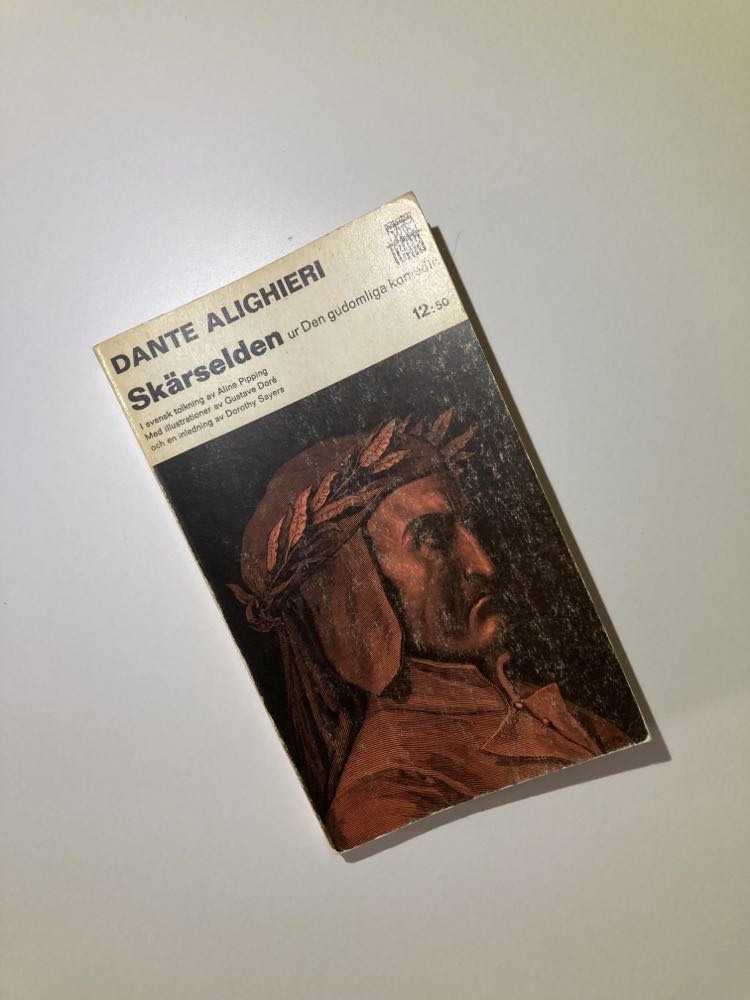
PURGATORIO

Author: Dante Alighieri
Year: 1966 (1321)
Publisher: Rabén & Sjögren
Language: Swedish (Translator Aline Pipping)

In the opening of the second part of Dante Alighieri’s Divine Comedy, “Skärselden” (“Purgatorio”), we find the narrator ejected from the lowest circles of Inferno onto the foothills of the mountain that is Purgatory. In Dante’s cosmology, the mountain of Purgatory rises as a counterpoint to Lucifer’s plunge into earth’s core, thus thrusting matter in front of him forward to create a mountain, roughly as tall as earth’s radius in the opposing end. Dante’s steadfast companion, Virgil, is still by his side. Unlike Inferno, the old man as a heathen and without hope of salvation has no prior knowledge of Purgatory but his wisdom will remain a beacon of advice and comfort to Dante during his continued exploration of the afterlife.  

Emerging from their long stay in the darkness of Hell, both men are blinded by the radiant sun. Although sounds of weeping and sorrow are heard around them here, too, the anguish is of a different kind. No longer the piercing screams of agony nor desperate cries of despair. The tears flowing in Purgatory are tears of insight and remorse. Contrary to the eternal damnation of Inferno, Purgatory offers the promise of redemption. Each soul, in its own time, will be admitted through the gates of Paradise. The role of the crucibles of Purgatory is to purge the sins from the souls in order to purify them before they enter the eternal joys in God’s presence. Though the sins of the souls saved in Purgatory rival those of the damned in Inferno, these sinners have acknowledged them and chosen the path to salvation by accepting the Lord as their saviour.

This truth is explicitly detailed in Canto 5 where Dante is first introduced to the negligent. Neither rejection nor defiance stain these souls. Rather, in their lifetime they succumbed to the trivial weakness of sloth and the distracting allure of simple pleasures which neutralised their capacity to embrace the highest love. Here, Dante moves on to encounter those who met their end suddenly, unprepared to meet their maker, such as victims of assassination or accidents. Yet, if only in the fleeting instant of their moment of death, the faintest whisper of submission to God’s will touched their hearts, they have been spared. For as Jesus replied to his disciples when they asked who can be saved

With men this is impossible, but with God all things are possible.*

Only through God, not our own actions, can our souls obtain salvation.

The divine beauty of humility is further elaborated on in Canto 11 picturing the souls steeped in the sin of pride and self-absorption. Those who used to look down upon their peers and cast disdainful gazed from their lofty heights, are here forced to carry the heavy burdens of their transgressions on their backs, making them bend down toward the earth, capable of seeing nothing but their own feet and the ground on which they trample, never to look down on anybody else again. Amidst this powerful reckoning, Dante and Virgil encounter Oderisi di Gubbio, the gifted painter, and Dante overflows with praise for his work. The painter gently dismisses him in a testimony of subdued humility.

“Brother!” said he, “with tints that gayer smile,
Bolognian Franco’s pencil lines the leaves.
His all the honour now; mine borrow’d light.”**

Praising your rivals and rejoicing in the success of others is just one of many kinds of love that God wants us to learn. If we cannot do it in life, we may get a second chance in Purgatory.

Similarly to Inferno, which descends through cycles of escalating sin drawing nearer Satan’s sulphurous lair, so too does the mountain of Purgatory reaching for the skies divided into circles of sinners edging ever closer to the promise of permanent redemption. Contrary to common belief, the gates of St Peter do not provide access to Paradise in Dante’s understanding, but to Purgatory. As God is omnipresent, his being is central to all that exists, including sin. All sin is the result of man’s perverted abuse of love, which is God. All who enter Purgatory are guaranteed salvation, but not without the purifying trials of time. The first circles after entering through the gates, are the circles of sins derived from misguided love. Here we find those who love themselves (superbia), those who love what others possess (invidia), and the ones encumbered by inverted love, i.e. hatred (ira). Beyond lies the domain of sinners who did not love enough; the carefree (acedia), while in the final three circles we find those whose lives were ensnared in excessive love; the greedy (avaritia), the gluttonous (gula), and the lustful (luxuria). Together they correspond to the seven deadly sins.

An intriguing cultural tidbit can be found in Canto 6 where Dante enumerates some dynasties that ruled the major city-states on the Italian peninsula. Among them he mentions the Montecchi, Cappelletti, Monaldi, and Filippeschi. Curiously, the first two were rivalling families in the annals of Verona’s tumultuous past, their story immortalised by a certain English playwright three centuries later.

“Skärselden” is sometimes mentioned as the least interesting part of The Divine Comedy but after reading and contemplating, there is good reason to reevaluate this statement. Far from the bombastic visual effects of the Inferno, the melancholic tone of “Skärselden” carries profound truths about the nature of sin and above all, the geography of redemption. If Inferno and Paradise are destinations, Purgatory is a journey. In the words of the Swedish poet Karin Boye

The day of plenty may not the greatest be,
greater still is the day of thirst, you see.
For sure, a meaning to our journey we can find,
yet the road itself is what is worth the grind.***


*  Matthew 19:25 KJV
**“The Vision of Purgatory”, Project Gutenberg 2004 translation: Henry Francis Cary
*** My own translation


söndag 24 mars 2024

PAUPER NOBILITY

Author: Agnes von Krusenstjerna
Year: 2010 (1935)
Publisher: Albert Bonniers förlag
Language: Swedish

In the maze of societal expectations, few endeavours are as effortlessly executed as keeping up appearances when one’s coffers harmonise with one’s station and lifestyle. But what drama looms when the reality of one’s means and the exigencies of one’s ideals diverge?

The hallmark of the old European nobility is that they do not labour for sustenance. Historically, their existence has been one of living off the fertile yields of their land, tended dutifully by others. Any work they deigned to undertake was veiled beneath the guise of service, be it to their community, their sovereign, or the nation at large. They could serve at the royal court, in government, diplomacy, or the military. Although they were often rewarded for this, there mere suggestion that their efforts might be tied to pecuniary rewards was to defile the sanctity of their noble lineage.

 In Europe, a seismic shift began to stir at the dawn of the Age of Enlightenment where noble titles were increasingly bestowed by monarchs upon favoured servants as an honour without an accompanying fiefdom or endowment. Thus, a new subclass of landless nobility was born. The momentum gathered further pace as the tide of revolutions swept across the continent, and even more so by the rapid formation of a capitalist class sprouting from the bourgeoisie during the industrialisation. By the end of the 19th century a significant number of impoverished aristocrats had emerged; a nobility that had no other asset to their name… than their name. And yet, despite their destitution, they were held to the same standards as their affluent peers in terms of lifestyle and material standards. Noblesse oblige, after all.

In the Swedish language, this class is commonly attributed the sobriquet “Fattigadel” (“Pauper Nobility”) which is also the title of the first book of Agnes von Krusenstjerna’s tetralogy known under the same name. Through the lens of her own upbringing as the daughter of a military nobleman, Krusenstjerna offers an intimate chronicle of societal upheaval and familial strife against the backdrop of a world in flux.

“Fattigadel” opens with a short scene featuring Viveka von Lagercrona as an elderly lady receiving a visitor in what seems to be a sanatorium or hospital. After this scene, Krusenstjerna guides the reader through the life of Viveka as the youngest child of four and the only daughter in a financially distressed noble family around the turn of the century. As her father, who, like the author’s own father, is a military officer, keeps changing commands around Sweden, the family is compelled to follow and young Viveka and her brothers are gradually shaped by their parents' responses to the vicissitudes of their class, and by the judgment of others.

Having read the poignant reports penned by the likes of Vilhelm Moberg and Väinö Linna chronicling the hardships of the landless proletariat of the same epoch, one finds oneself grappling with an intuitive difficulty to immediately sympathise with the upper class Lagercrona children and their seemingly imagined misery. Befitting the commander of the regiment, a stately mansion with servants are provided to Viveka’s father and his family. Here, amidst the plush comforts of their domain, Viveka and her siblings can spend their time frolicking carefree, oblivious of the toil that that besets children of labourers and crofters. Their living conditions could not be any more different. However you look at it, the nobility was struggling to keep up with their class, while the workers were struggling to break free from theirs.

A fleeting moment wherein the lives of the privileged Lagercronas converge with the humble existence of their elderly household servant is when one of Viveka’s brothers finds out that the old woman keeps two canaries in a cage at her home. In a life defined by hard work and poverty, the canaries embody what little happiness the old woman has in life. Lady von Lagercrona, eager to win the affection of her son by presenting him with an exotic Christmas gift, takes little notice of this and demands that the woman sell her the canaries at a ridiculously low price. Unable to refuse the desire of the assertive noblewoman, the woman succumbs, is bereft of her only source of solace and left with a handful of change while the von Lagercronas can add another curiosity to their household for the superficial entertainment of their spoilt son. Krusenstjerna never returns to the fate of the elderly woman after the scene of the transaction. She remains an inconsequential witness to the capricious whims of those enveloped in privilege.

Even so, I am compelled to refrain from downplaying Viveka’s internal strife and her experience of inadequacy. It is well documented that negative stress appears when the gap between the expectations and the individual’s ability to meet with them becomes insurmountable and this is precisely what Viveka and her siblings are faced with. From an early age, they are confronted with the scorn of their more affluent peers and the ceaseless efforts to mask their poverty and want, not to mention handling their hysterical and overbearing mother. Anxiety and depression would be expected effects of such an upbringing. Suffering has not hierarchy and I hesitate to compare woes on an individual level as someone else’s misfortune rarely serves to take the edge off of one’s own.

In these poignant reflections, I find myself incapable of escaping the confrontation with the echoes of my own childhood. Though disparate in nature and historical context, the challenges faced by the von Lagercrona family resonate eerily with my own lived experiences of growing up in an atmosphere lined with the bitterness of bygone family greatness.

Irrespective of its contents, the literary value of “Fattigadel” remains undisputed as the book is objectively very well written. The characters, particularly the children, are meticulously crafted and easily distinguishable, and they behave predicably according to their individual personality. My only hesitation is with regard to the disposition of the novel which begins as a story that develops chapter for chapter in linear progression, only to change characteristics in the last quarter of the book to more resembling a series of independent snapshots or anecdotes from the life of the von Lagercronas, as if representing pages torn from a diary. Maybe the author’s own.  

I have three more parts to read of this series but I have a feeling that I may have reason to return to this issue in more depth further down the road.


onsdag 13 mars 2024

UNDER THE NORTH STAR - I

Author: Väinö Linna
Year: 1988 (1959)
Publisher: Wahlström & Widstrand
Language: Swedish (Translator N-B Storbom)

In the quiet moments of reflection, one can still hear the echoes of the struggles of generations of the past reverberating through the annals of time. Theirs was a world cloaked in the shadow of hardship, where each dawn brought forth a new challenge to overcome and each dusk offered but a fleeting respite from the burdens they bore. Through the veil of adversity they found solace in the simplicity of their bonds, forged neither in gold nor in silver, but in shared despair and sacrifice.

No one has described these times better than the Swedish writer Vilhelm Moberg (see e.g. my review from October 2022), but there are a few who stand shoulder to shoulder with him. The Russian Maxim Gorky is one. The Finn Väinö Linna is another.

The first book in Väinö Linna's epic trilogy "Under the North Star," is “Högt bland Saarijärvis moar” (published in English under the same title as the whole trilogy*). It unfolds with a poignant scene as the stalwart farmhand Jussi receives permission from the local pastor to reclaim a desolate plot of marshland belonging to the parish and forge a new life upon it. Jussi’s journey is one of unparalleled hardship, matched only by his unyielding resolve as we follow him, his kin, and his community, through the tumultuous years of the beginning of the 20th century.

I have long advocated the necessity for Swedes to immerse themselves in the rich universe of Finnish 20th century literature, particularly the proletarian and post-war narratives. Such immersion not only grants us insight into the trials of our predecessors but also contextualises their struggles within the broader spectrum of our shared Nordic heritage. A Swedish reader of "Högt bland Saarijärvis moar" will no doubt recognise the echoes of the bygone plight of the Nordic peasants a century ago and the hard labour, oppressive landowners, disease, and the unrelenting scorn of the privileged elite.

But besides that, there were two dynamics in the reality of a Finnish farmhand, that would seem strange to a Swedish crofter from the same period: the tug-of-war between languages and the resistance against an foreign sovereign. Despite the dominance of Russian overlords, the Finnish upper echelons clung to the Swedish language as a symbol of status and education. In this era of societal upheaval, marking the advances of Socialism, Liberalism, Temperance, and the emancipation of women, the promotion of Finnish language, known as Suometarianism, emerged as a beacon of cultural identity. In Linna’s view, this was an upper-class project as the under-class did not really care if their abusers spoke Swedish, Russian or Finnish with one another.

Linna skilfully portrays this linguistic struggle through the whimsical exchanges of the pastor's la-di-da wife, whose insistence on Finnish discourse incites both hilarity and introspection. Although both she and her husband hail from the urban elite, and consequently speak Swedish better than Finnish, she insists on forcing the monolingually Swedish Baron to speak Finnish whenever conversing with them, and gives her and the pastor’s children classic Finnish names. In Chapter 5, her attempts to whip up indignation among the altogether indifferent labourers against the so-called February Manifest issued by Tsar Nicolai II which would transfer power from the reasonably autonomous Finland to Russia, result in several humorous encounters.

As a writer, Väinö Linna shows true mastery and his love for his homeland and its history shines through every character and every scene.  I furthermore find myself compelled to pay tribute to the translator whose Herculean task of rendering Linna’s carefully crafted working-class Finnish vernacular into Swedish deserves the highest commendation. Linna lets his characters converse in a provincial Finnish which is reproduced in a non-standardised semi-phonetic writing designed to convey the flavour of the language of the uneducated. The translator was himself a Swedish-speaking Finn and must have had to reach deep into the swedophone provinces of Finland and thereafter ruralise the language to obtain the right effect. His laborious efforts ensure that the essence of Finnishness remains intact, bridging cultures and allowing literature to transcend linguistic boundaries.

It is no wonder that “Högt bland Saarijärvis moar” has become a classic in Finnish literature. It is a testament to the indomitable spirit of those who toiled the earth and forged a nation through hardship and sacrifice. Their sweat may have long evaporated and tears dried, yet the echoes of their labour and the resonance of their laughter still reverberate through the majestic pine forests of Finland.


*The Finnish original assigns no individual titles to each part of the trilogy which is simply called Here, Under the North Star parts 1, 2, and 3, but the Swedish publisher named each part after the opening words of different famous poems.